
SAIF at HKIS CPD 2026: Navigating Fire Safety Compliance with AIoT

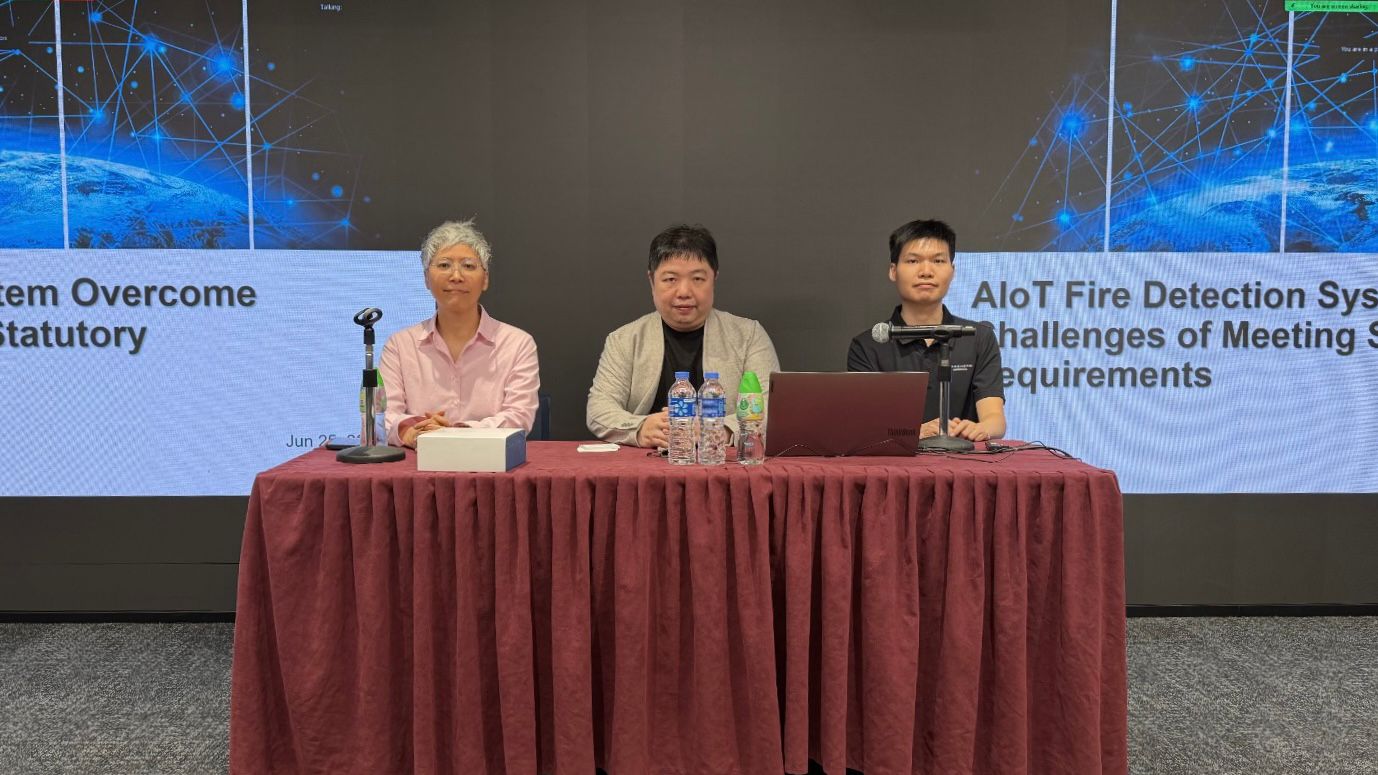
Our team was invited to speak at a CPD seminar hosted by the Hong Kong Institute of Surveyors (HKIS), organised by the Property and Facility Management Committee under the Property & Facility Management Division (PFMD).
The 90-minute online session — "AIoT Fire Detection System: Overcoming Challenges of Meeting Statutory Requirements" — brought together property professionals, surveyors, and facility managers to discuss how technology is reshaping fire safety compliance in Hong Kong.
The Challenge: Older Buildings, Real Barriers
The Fire Services Department (FSD) has been actively promoting fire safety improvement works for composite and domestic buildings of six storeys or below constructed on or before March 1987. These buildings are required to comply with statutory requirements for hose reel systems and manual fire alarm installations.
In practice, the path to compliance is rarely straightforward — especially for "three-nil buildings" with no owners' corporation, residents' organisation, or property management company in place. Common barriers include:
Coordination difficulties across stakeholders with no central management
Spatial constraints that make conventional system installation impractical
Financial limitations with no collective funding mechanism
These challenges have made compliance a persistent pain point across much of Hong Kong's older building stock.
A Regulatory Opening: FSD-Accepted IoT Solutions
A key focus of the session was an important development in the regulatory landscape: the FSD now accepts IoT Fire Detection Systems and Portable Fire Extinguishers as alternative solutions to correspondent statutory requirements.
This recognition is significant. It means building owners are no longer limited to conventional infrastructure approaches — and technology-led solutions now have a clear, compliant pathway.
How F.A.S.T Addresses This
F.A.S.T (Fire Alarm Smart Technology) was built precisely for this kind of environment. It combines over 25 years of hands-on fire engineering experience with AI and IoT capability to deliver:
24/7 real-time monitoring across connected devices and systems
AI-driven predictive maintenance — detecting anomalies early before they escalate
Continuous data logging — supporting compliance audit trails and post-incident investigation
Cross-system integration — unifying fragmented fire infrastructure into a single dashboard
Non-intrusive deployment — working alongside existing AFA systems without replacing certified control logic
The result is fire safety management that meets regulatory requirements while being operationally leaner and more sustainable.
Key Takeaways from the Session
Pre-1987 building compliance is achievable without full infrastructure replacement — IoT provides a recognised, practical route.
"Three-nil buildings" are not beyond reach — technology can significantly reduce the coordination and cost burden.
Predictive maintenance is a risk management tool that reduces both false alarms and long-term operational costs.
Data continuity matters — objective system records are critical when incidents occur and accountability is required.
The regulatory environment is evolving to accommodate technology — the window to act is open now.
Thank you
We are grateful to HKIS and the Property and Facility Management Committee for the opportunity to share our work with Hong Kong's professional surveying community, and to all attendees for their thoughtful questions and discussion.
If you'd like to learn more about how F.A.S.T applies to your portfolio, we welcome the conversation.